




Naval education and training facilities .
With the advent of steamships, the Navy also had to be better organized. In the days of sailing ships, only officers had training and sailors and other men were trained on board. With the advent of steamships, ordinary seafarers also had to have preliminary training to be able to go to sea by modern means. A great need arose for training facilities and resources in the Navy.
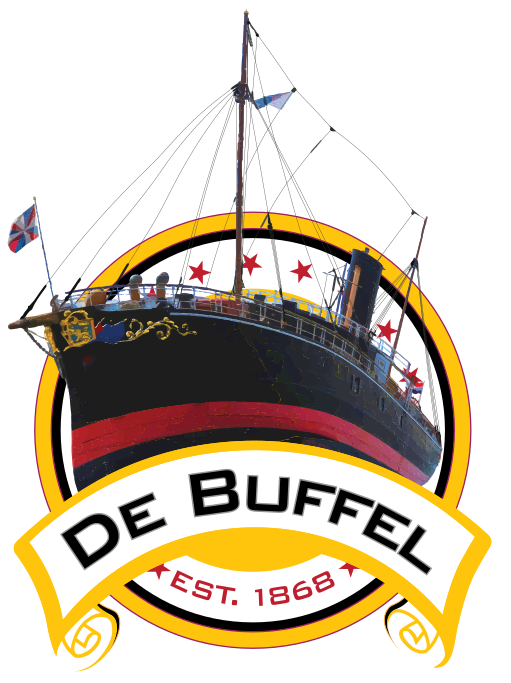
Facilities were needed for the training of various service branches. The Navy hardly had any barracks and buildings outside the KIM in Den Helder and the Quartermaster School in Leiden and thus had to rely on lodge ships. Previously, the Navy had also used lodge ships, but usually only to temporarily house the crew of a ship under maintenance or construction. Much of the larger ships that were no longer suitable from the fourth quarter of the nineteenth century were assigned a passive role as lodging or waiting ships. Rebuilding mostly involved removing the masts, chimney, machinery and armament and expanding the accommodation. On the “Buffalo,” 350 sailors-in-training were housed in the ship, which was originally designed for 115 sailors. A cage ramp was installed on deck to hold the men’s berths during the day. In addition, a tent structure was installed to protect the upper deck from weather. This was later replaced by a wooden preservation canopy.
Timeline lodge, waiting ship:
- 01-04-1894 Hellevoetsluis (quartermaster training)
- 11-06-1896 Hellevoetsluis (sailor training)
- 1920-1926 Flushing.
- 1926-1940 Den Helder
- (training naval mates flying camp de Kooy)
- 1940-1946 Amsterdam
- (internment of naval personnel)
- 15-05-1946 Rotterdam
- (submarine service)
- 01-09-1947 Amsterdam
- (TOKM)
- 01-09-1948 Den Helder
- (lodge ship Commander of the Navy)
- 01-02-1949 Rotterdam
- (lodge ship approach crew Karel Doorman).
- 1949-1951 Den Helder
- (lodge ship for the benefit of ARGIS)
- 1949-1973 Amsterdam
- (lodge ship TOKM)
- 18-01-1974 Transferred to Domains


More History


